
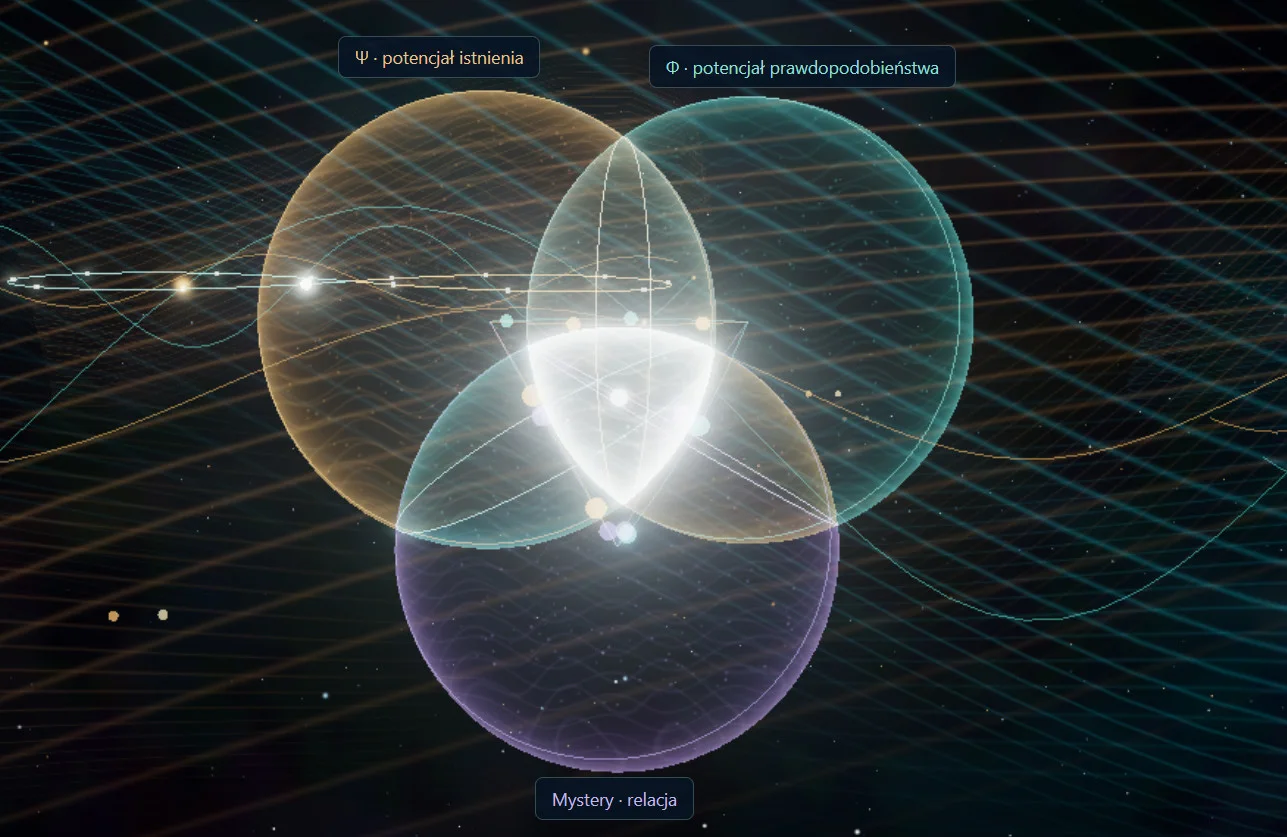
Q Theory is a Holistic Interpretation of Almost Everything — a project of inquiry that begins where the traditional divisions of science end. It treats mathematics, physics, psychology and philosophy as different languages for describing a single, deeper structure of reality, rather than as separate islands.
INTRO — A First Look at Q Theory
The beginning of a fascinating journey to understand the world and yourself.
Q1 — Q Theory — What Is the World Really?
An introduction to Q Theory as a fascinating journey beyond conventional ideas about reality.
Q2 — Definitions of the Basic Concepts
Part two of Q Theory introduces an important distinction between normative and fuzzy domains and shows why not everything can be described using the same language. This episode brings structure to thinking about science, knowledge, definitions and the foundations of the theory of universal structures.
Q3 — The Concept and the Birth of Structure
What is a concept, and how does a definite structure emerge from an undefined possibility? Part three of Q Theory shows how observation helps create what we regard as an object.
Q4 — A World Without Points
Part four of Q Theory shows why the point cannot serve as the foundation for describing reality and how it is replaced by the concept — a fuzzy object dependent on observation.
Q5 — Object, Observer and Image
Part five of Q Theory explains how an object emerges in relation to an observer and why an image is never the same as ‘pure’ reality.
Q6 — A New Mathematics
Part six of Q Theory shows that truly generalised mathematics rests not only on numbers, but on relationships, structures, processes and symmetries. It invites a completely new view of mathematics as a language for describing physics, psychology and even music.
Q7 — The World Is a Process, Not a Collection of Things
Part seven of Q Theory shows that the world we perceive is only an interpretation created by the mind. This episode introduces one of the theory’s key assumptions: reality is founded on processes, relationships and structures, rather than ready-made objects.
Q8 — Existence, Relationships and Antistructures
An introduction to proper structure, antistructure and the equation of existence, which becomes the central theme of the next part of the theory.
Q9 — The Square Principle and the Symmetry of Relationships
An expansion of the square principle, presenting four basic perspectives for describing an object, a relationship and an observation.
Q10 — Arithmetic Operations Reconsidered
An attempt to completely reassess the school understanding of addition, multiplication, exponentiation and basic operations.
Q11 — What Is a Number Really?
The question of what a number is and what numbers actually describe leads here to a much broader perspective than school mathematics.
Q12 — Zero, Absence and the Birth of Number
Reflections on zero, absence and the foundations of number as building blocks of a more general understanding of mathematics.
Q18 — Coordinates, Frames of Reference and New Descriptive Tools
An introduction to coordinates and frames of reference as key tools for a deeper description of objects and relationships.
Q19 — The Secret Message of the Self
An episode about a single fundamental property that may underlie consciousness and connect humans with other forms of life.
Q20 — Reinterpreting the World Through the Self
A deeper exploration of the self as a central element of consciousness, perception and a new understanding of reality.
Q21 — The Zero Paradox and Definitions
This episode returns to number, zero and definitions, showing that mathematics and physics should not be separated, because number arises from the possibility of classification and physical probability.
Q22 — The Zero Paradox and Equivalence Classes
Further reflections on zero, numbers and abstraction, leading to a new view of mathematical operations as operations rooted in the physical world.
Q23 — The Mystery of the Irrational Number
This episode reveals a new meaning of irrational numbers and shows that their ‘mystery’ may have a deep physical significance, beyond symbolism alone.
Q24 — All Arithmetic Operations in Q Theory
A concise introduction to a new arithmetic in which operations have structural, physical and psychological meaning.
Q25 — Gluing — Nature’s Most Common Operation
A presentation of gluing as a fundamental operation found in nature, yet almost absent from traditional mathematics education.
Q25B — Gluing: An Operation More Fundamental Than Addition
This episode shows that before conventional addition, there is an even more basic process — gluing. It describes many natural phenomena better than school arithmetic does.
Q26 — Composition — An Operation More Fundamental Than Addition
An expansion of the new arithmetic through composition, which turns out to be more important than conventional addition.
Q27 — Collecting as a Process of Joining Objects
This episode introduces collecting as one of the most fundamental operations, preceding conventional set theory and important for the further development of Q Theory.
Q28 — Making Common as an Arithmetic and Image-Related Operation
A new operation presented both as a mathematical mechanism and as a tool for understanding images and relationships.
Q29 — Addition Is Not What You Were Taught at School
A reassessment of addition by revealing its deeper meaning in mathematics, physics and the theory of structures.
Q30 — Multiplication as Multiplicative Emergence
An episode about why multiplication is more than simplified addition. Q Theory shows that multiplication produces new qualities and has a much deeper meaning than we were taught at school.
Q31 — A New Interpretation of Imaginary and Complex Numbers
Imaginary and complex numbers are presented in a simpler, more intuitive way, based on a more general understanding of multiplication.
Q32 — The Imaginary Unit Is More Than the Square Root of Minus One
This episode challenges the school definition of the imaginary unit and proposes a deeper, more physical interpretation of the concept.
Q33 — Why Earth Orbits the Sun and How to Calculate Without Fractions
An attempt to understand frames of reference through examples of motion, percentages, degrees and minutes, without resorting to impenetrable formalisms.
Q34 — The Relativity of Numbers and the Speed-of-Light Limit
Reflections on the relativity of numbers combined with the question of why the speed of light cannot be exceeded.
Q35 — The Simplicity of the Complex Number Model
A clear presentation of the complex number model based on simple geometry and a new interpretation of the imaginary unit.
Q36 — How Simple Equations Give Rise to a Hole and the Golden Ratio
A demonstration that simple operations on an object and its frame of reference can yield surprisingly profound constants and structures.
Q37 — The Golden Ratio and Fibonacci Numbers as the Self-Organisation of Matter
Q Theory interprets the golden ratio and Fibonacci numbers as manifestations of matter spontaneously organising itself.
Q38 — An Underappreciated Constant as Another Complex Solution
An expansion of earlier episodes with another important constant that emerges from simple operations on an object and its frame of reference.
Q39 — The Constant Tau Instead of the Myth of Pi
A strong argument that in many situations tau, rather than pi, better reflects the actual structure of the phenomena being described.
Q40 — The Number e as a Record of Symmetry in Time
An interpretation of the number e as a counterpart of tau, situated in the rhythm and symmetry of time rather than the geometry of a circle.
Q40B — The Number e in a Nutshell
A short version of the main intuition: the number e is presented as the temporal counterpart of tau and a key to understanding the symmetry of change.
Q41 — What Kinds of Truth Are There, and How Many?
A practical Q Theory episode showing that truth has more than one form. It explores different kinds of truth that influence our thinking, personality and perception of the world.
Q43 — Creatinium and the Phantom of Reality
An attempt to answer the question of what spacetime, matter and reality itself actually arise from.
Q44 — Reality as a Phantom of Potentials
An expansion of the thesis that reality is not given from the outset, but emerges as a phantom of interactions between potentials.
Q45 — Light as the Quintessence of Reality’s Birth
A demonstration that the birth of reality is always accompanied by light, understood as a key sign and carrier of its constitution.
Q46 — The Human Being as a Process, Not an Object
A return to one of the series’ most important theses: a human being is not a finished thing, but a dynamic process unfolding over time.
Q47 — All Structures Share the Same Architecture
A powerful reminder of Q Theory’s central intuition: the world is fractally similar because all structures share a common architecture.
Q48 — Marketing Psychology Derived from a Single Diagram
A practical application of Q Theory to describing marketing, the augmented product and the psychology of reception.
Q49 — The Human Being from the Market’s Perspective
An expansion of the previous episode exploring how the market constructs an image of the human being and how a person functions as a psychological and market entity.
Q50 — Why a Wise Person Is an Idiot to an Idiot
An episode about the relativity of judgements and how an observer’s structure influences whom they consider wise or foolish.
Q51 — Albert Einstein’s Formula and Its Meaning in Psychology
A bridge between physics and psychology: Einstein’s famous formula is read in a new, more universal context.
Q52 — Where Emotions Come From and What They Are
This episode shows that emotions can be described as specific structures and processes, rather than merely elusive mental states.
Q53 — Where Do Emotions Come From?
Part one of an expanded analysis of emotions as structures and antistructures arising from a person’s relationship with their surroundings.
Q54 — Multistructures of Emotions and Anti-Emotions
An expansion of the theory of emotions through derived relationships, which give rise to entire emotional systems rather than individual states alone.
Q55 — How Intuition and Intelligence Arise
An attempt to explain intuition and intelligence as outcomes of the development of structures and the transition from simple systems to multistructures.
Q56 — The Mystery of Zero and Existence. Part I
Part one of one of Q Theory’s most fundamental topics: what zero really is and why it should not be uncritically regarded as an ordinary number.
Q57 — The Mystery of Zero and Non-Existence. Part II
Part two of the analysis of zero leads to an even more difficult question: do zero, nothing and non-existence mean the same thing? This episode shows that they do not.
Q58 — The World’s Most Beautiful Symmetry
The final episode in the series about zero, non-existence and the symmetry whose local breaking leads to the emergence of being.
EXTRA — The Genesis Paradox — Could God Have Created the World?
On faith, logic, infinity and one of the most startling philosophical questions: could a being that has always existed really have created the world at any point?